NARRATIVAS ENTRELAÇADAS
Este texto foi escrito em meio a um emaranhado de montanhas, viagens de avião, trajetos de carro, trens, junto aos oceanos Pacífico e Atlântico. O que é a vida na Terra como ser humano senão um emaranhado de emoções, momentos, memórias? O emaranhado precisa ser desembaraçado. Há várias formas de lidar com essa realidade: puxamos o cabelo com força, acompanhados de sons e palavras de irritação; ou cortamos com a tesoura para evitar enfrentar o problema; ou simplesmente ignoramos, porque um dia ele se resolverá sozinho; ou, como acontece na maioria das vezes, ele apenas fica mais espesso, mais confuso e mais labiríntico. Todas essas são formas de desembaraçar.
Nesse processo, desenvolve-se uma história, uma narrativa. Obtém-se um porquê, um começo, protagonistas e antagonistas e um chamado “fim da história”. Tudo isso pode ser contado de diferentes maneiras. E, com o tempo, o “humor” do interlocutor, a abertura da mente e a atenção do ouvinte, assim como o contexto da narrativa, acrescentam detalhes, ângulos e perspectivas. E, ainda assim, ficamos mais emaranhados. O nó do cabelo exige um exercício de profunda paciência, com resiliência e calma, para refletir sobre sua origem e seu futuro.
O ato de pentear o cabelo pela manhã é intimamente responsável pelo início do dia: um sinal que todos conhecemos bem — “já estou quase pronto, só preciso pentear o cabelo”. Ou então indica uma transformação e uma necessidade de reinvenção: “não sei que penteado usar no casamento da Isabelinha”. É um momento de mudança que precisa ser marcado, pois ninguém começaria o dia de um grande evento sem ir ao cabeleireiro. “Você ficaria tão bem ruiva com esses olhos verdes”: a opinião de quem mais nos ama, pintando-nos como uma tela. Isso é afeto.
“Um bom corte de cabelo muda a vida de alguém”: quem nunca ouviu esse poema? Ou os sonhos e projeções mais íntimos: “preciso ir à Turquia para fazer um transplante capilar”. Entra o anúncio da Inspariya “Hold my hair”: sentir a intensidade da mão de quem mais nos deseja, seja brincando com cada fio de cabelo ou prendendo-o em um rabo de cavalo. “Guardei por anos a trança da minha mãe e da minha avó em uma pequena caixa de papel”: um talismã vivo do espírito que nos lembra quem fomos em determinado momento da vida.
“Você sabe fazer trança? Quero uma daquelas que começam aqui em cima”: trata-se de companheirismo e amizade; crianças e amigas se reúnem no corredor da escola, sentadas em um muro alto, todas alinhadas, ensinando e trançando o cabelo umas das outras. “Eu amo o cheiro do seu cabelo”: cheirar secretamente o cabelo daqueles que nos deram abraços de felicidade, que ofereceram o ombro para as lágrimas ou os lábios para os beijos, e lembrar como a memória pode nos transportar quando esse aroma cruza o nosso caminho… Talvez ele até apareça em uma carta inesperada, dentro de um envelope antigo, que esperou o dia certo para viajar.
Manias de jogar o cabelo para trás, enrolar mechas nos dedos, cortar pontas duplas, torcer o cabelo quando estamos estressados, esconder o cabelo com bonés com frases inspiradoras — “Hoje não fiz nada” (Thomas Lélu) — no inverno, e chapéus de palha do Algarve para a praia, usar grampos em forma de flores de hibisco, ou comprar elásticos de cabelo infinitos em formatos, cores e materiais que, mesmo que compremos um todos os dias, sempre aparece outro escondido dentro de uma bolsa ou no bolso do casaco…
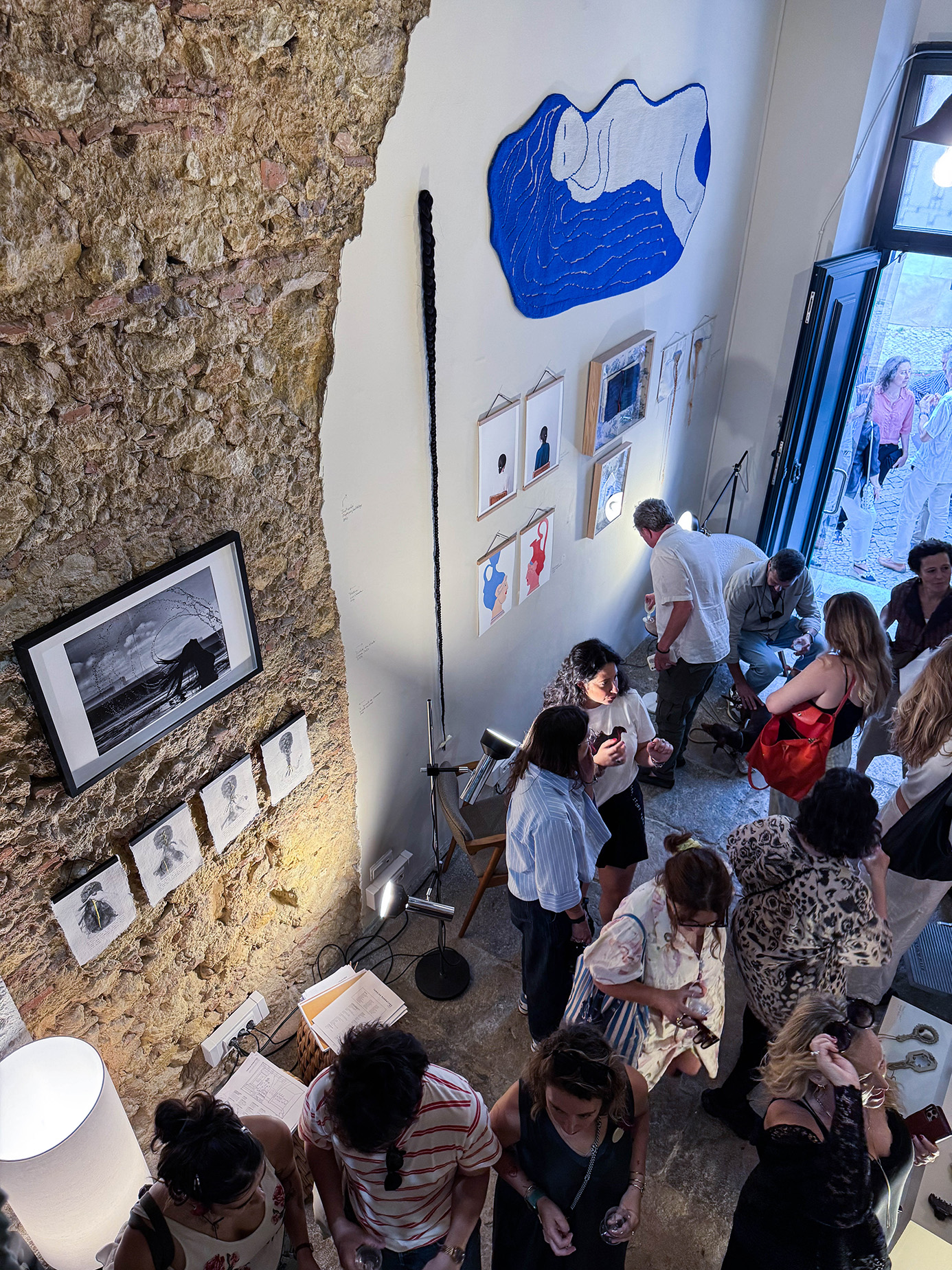
Projetamos quem somos no nosso cabelo. E essa é a ode que você encontra aqui. Os artistas refletiram. E, como era de se esperar, surge um nível ainda maior de emaranhamento entre a quantidade de artistas, objetos, expressões artísticas e interpretações que você encontrará aqui. Como espectadores, escolham a melhor forma de desembaraçar e esperamos que isso ajude a revelar a melhor técnica para desfazer qualquer emaranhado que possa surgir.
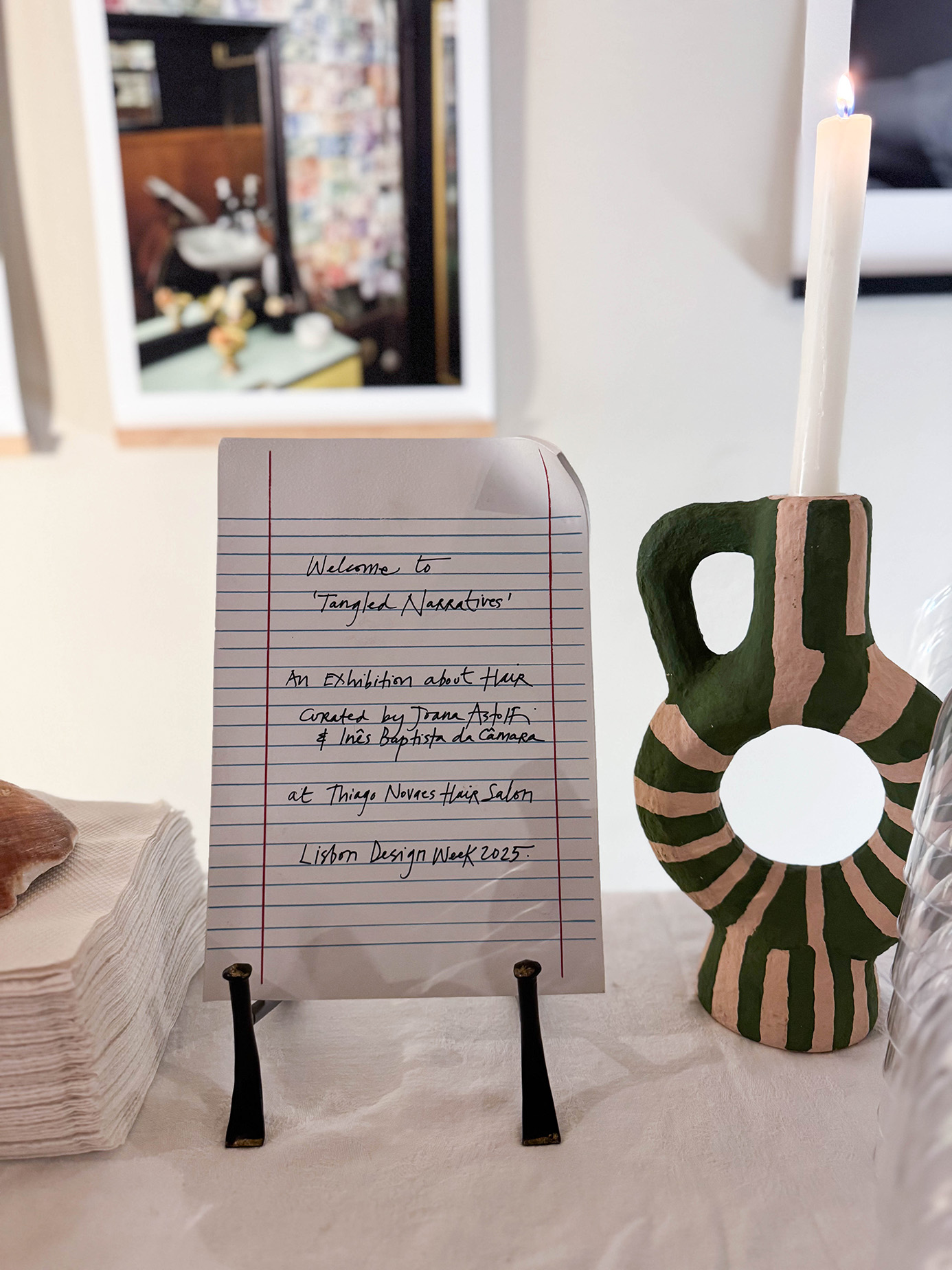
Joana Astolfi e Inês Baptista da Câmara
Curadoras
Salão de cabeleireiro - Lisboa
TANGLED NARRATIVES
This text was written amidst a tangle of mountains, airplane trips, car rides, trains, by the Pacific and Atlantic Oceans. What is life on Earth as a human being if not a tangle of emotions, moments, memories? The tangle needs to be untangled. There are several ways to deal with this reality: we pull our hair out forcefully accompanied by sounds and words of irritation, or we cut it with scissors to avoid dealing with the problem, or we simply disregard it because one day it will resolve itself, or, as happens most of the time, it will just get thicker, more confusing, and more labyrinthine. All of these are ways to untangle.
In this process, a story develops, a narrative. One obtains a why, a beginning, protagonists and antagonists, and a so-called “end of the story.” All of this can be recounted in different forms. And, over time, the “mood” of the interlocutor, the openness of mind, and the attention of the listener, as well as the context of the narrative, add details, angles, and perspectives. And yet, we get more tangled. The hair knot demands an exercise of deep patience, with resilience and calm, to reflect on its origin and its future.
The act of combing in the morning is intimately responsible for the start of the day: a sign that we all know well, “I’m almost ready, I just need to comb my hair.” Or, it indicates a transformation and a need for reinvention: “I don’t know what hairstyle to wear to Isabelinha’s wedding.” It’s a moment of change that must be marked because one wouldn’t start the day of a big event without visiting the hairdresser. “You would look so good as a redhead with those green eyes”: the opinion of someone who loves us most, painting us like a canvas. It’s affection.
“A good haircut changes someone’s life”: who hasn’t heard this poem? Or the more intimate dreams and projections: “I need to go to Turkey for a hair transplant.” enter Inspariya ad “Hold my hair”: feeling the intensity of the hand of the one who desires us most, whether playing with each strand of hair or tying it in a ponytail. “I’ve kept my mother’s and grandmother’s braid for years in a little paper box”: a living talisman of the spirit that reminds us who we were at a certain point in life.
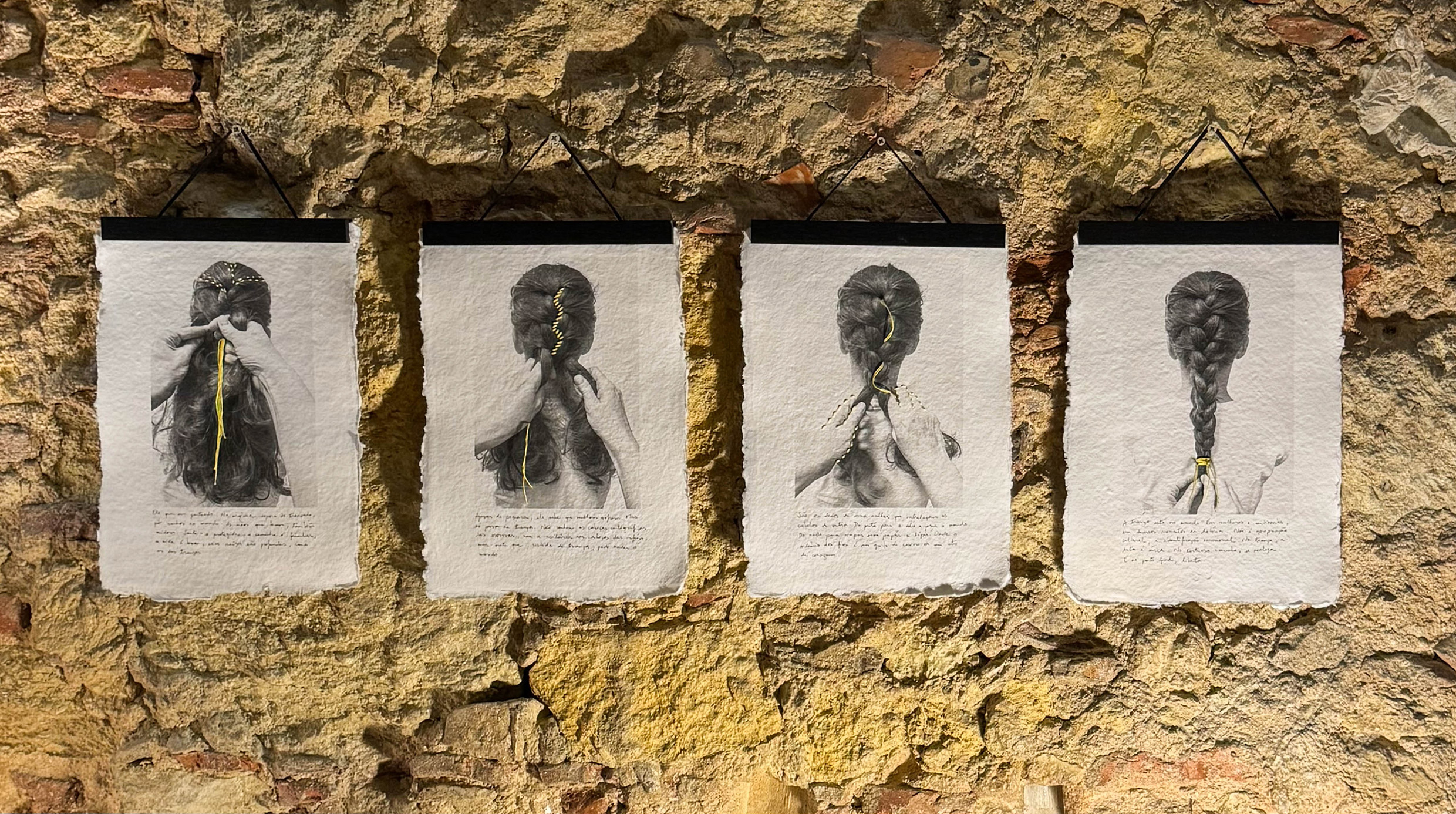
“Do you know how to braid? I want one of those that come from up here”: it’s about companionship and friendship; children and friends gather in the school hallway, perched on a high wall, all lined up, teaching and braiding each other’s hair. “I love the smell of your hair”: secretly smelling the hair of those who gave us hugs of happiness, who offered their shoulder for tears or their lips for kisses, and recalling how memory can transport us when that scent crosses our path... Perhaps it even shows up in an unexpected letter, inside an old envelope, that waited for the right day to travel.
Tics of pushing hair back, curling locks with fingers, trimming split ends, twirling hair when stressed, hiding hair with caps with inspirational phrases “Today I did Nothing” (Thomas Lélu) in the winter, and straw hats from the Algarve for the beach, using hairpins shaped like hibiscus f lowers, or buying endless hair elastics in shapes, colors, and materials that even if we buy one every day, another one hides in a bag or a coat pocket...
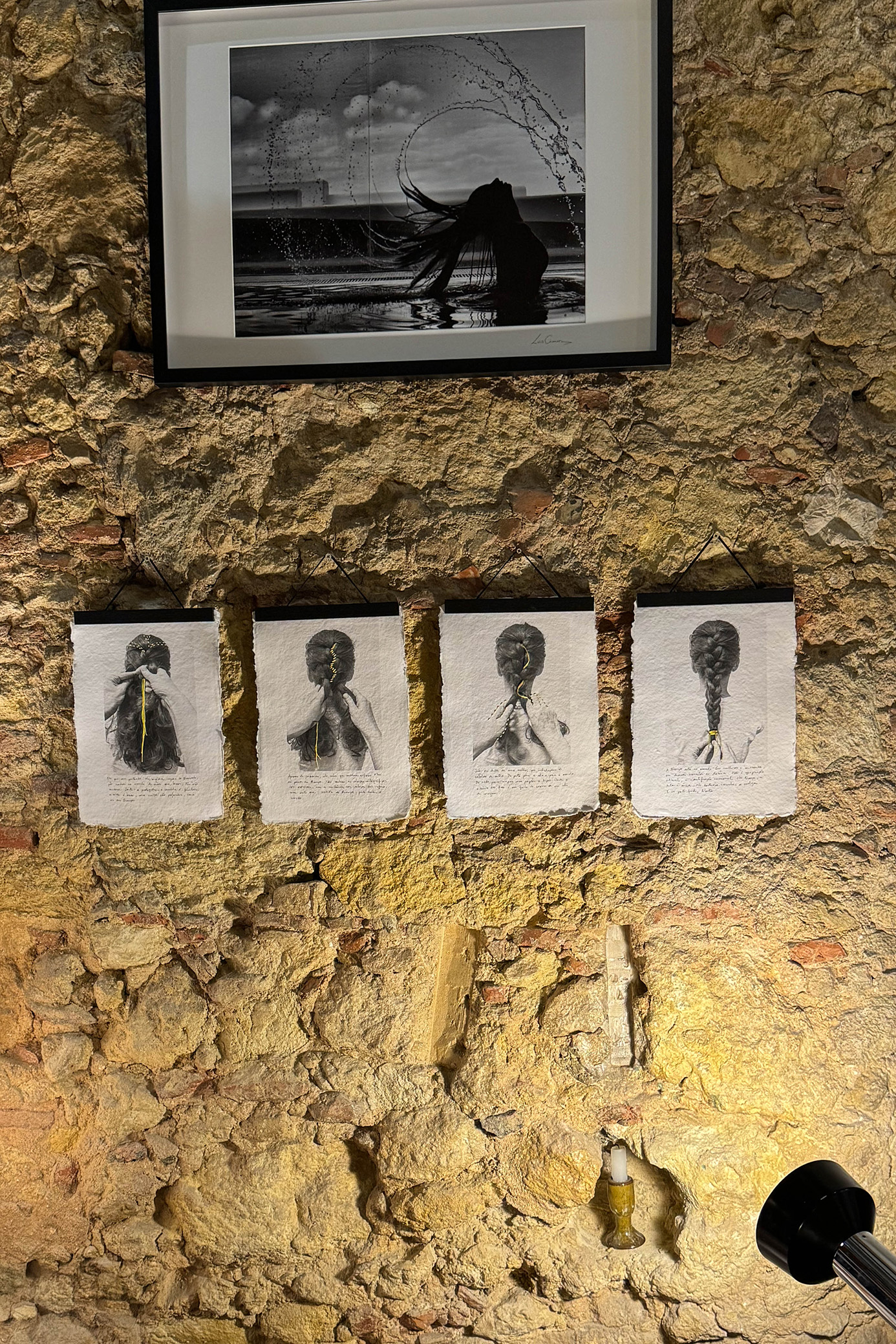
We project who we are in our hair. And that is the ode you can find here. The artists reflected. And as expected, a higher level of tangling arises among the number of artists, objects, artistic expressions, and interpretations that you will find here. As spectators, choose the best way to untangle here and we hope it helps to unravel the best technique for untangling whatever may come.
Joana Astolfi e Inês Baptista da Câmara
Curators
Hair Salon - Lisbon